Board of Peace
Trump Launches ‘Board of Peace’ in Davos
On January 22, 2026 U.S. President Donald Trump hosted a signing ceremony for the founding charter of his “Board of Peace” on the sidelines of the World Economic Forum in Davos, Switzerland. More than 20 global leaders joined Trump onstage, and according to a list that the White House released on Thursday, some 25 countries have accepted the invitation so far, including Argentina, Belarus, Egypt, Hungary, Pakistan, Saudi Arabia, Turkey, and the United Arab Emirates.
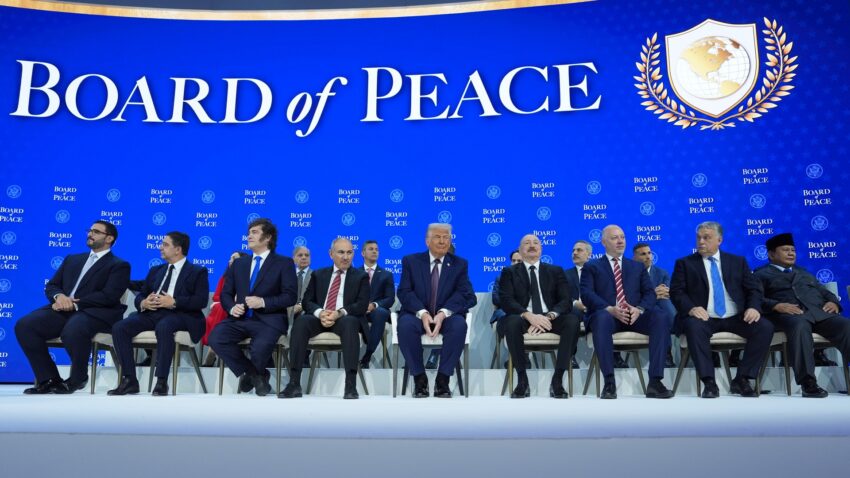 President Donald Trump, center, poses with international leaders after the signing of a Board of Peace charter during the Annual Meeting of the World Economic Forum in Davos, Switzerland, Thursday, Jan. 22, 2026. (AP Photo/Evan Vucci)
With nearly 25 countries already signed on, critics fear that the new body could challenge the United Nations’ authority.
The board, which was initially conceived as a postwar transitional body for Gaza following the cease-fire between Israel and Hamas, was formally backed by the U.N. Security Council in November 2025. The charter signed Thursday, however, does not explicitly mention Gaza, reflecting Trump’s ambition to expand the body’s mandate. The document also grants Trump the authority to name his successor, veto most decisions, and issue directives to implement the board’s mission.
“I think we can spread out to other things as we succeed with Gaza,” Trump said. “Once the board is formed, we can do pretty much whatever we want to do.”
What Trump’s “Board of Peace” claims to be
Donald Trump’s proposed “Board of Peace” (sometimes described as a commission or advisory body) is framed rhetorically as:
- A mechanism to end “endless wars”
- A body to reward peace-making (sometimes linked to Nobel-style symbolism)
- A corrective to the foreign-policy establishment (“the Blob”)
- A signal of transactional realism over ideological interventionism
On the surface, this sounds like a de-escalatory move. In isolation, one could read it as anti-imperial.
That interpretation collapses when placed in historical and structural context.
Structural context: the U.S. as a bullish system
Several persistent traits define U.S. behavior regardless of administration:
1. Primacy preservation
The U.S. seeks to remain the agenda-setter in security, finance, and norms.
2. Moral framing + coercive capacity
Actions are narrated as peacekeeping, democracy, or stability—even when outcomes are destabilizing.
3. Delegation of violence
Shift from direct occupation to:
- Sanctions
- Proxies
- Financial warfare
- Intelligence operations
4. Domestic legitimacy management
Foreign policy is shaped to manage internal political fatigue rather than to reduce external coercion.
Trump does not challenge these pillars. He rebrands them.
Likely real objectives of the “Board of Peace”
1. Reframing dominance, not ending it
The “Board of Peace” is best understood as a narrative instrument, not a policy one.
Its function is to:
- Present U.S. coercion as deal-making
- Replace “liberal interventionism” with transactional enforcement
- Signal: “We don’t want war—but we will impose terms.”
This aligns with Trump’s consistent pattern:
Peace is defined as compliance after pressure, not mutual restraint.
2. Internal power struggle with the foreign-policy establishment
The board is also aimed inward:
- Undermines State Department, intelligence agencies, and think-tank networks
- Centralizes legitimacy around the executive
- Allows Trump to claim peace outcomes while bypassing institutional checks
This mirrors earlier authoritarian-leaning patterns we discussed:
- Replace institutions with personalized councils
- Substitute process with loyalty
- Frame dissent as warmongering or sabotage
3. Cost control, not moral restraint
Trump’s objection to war has never been humanitarian.
It is consistently:
- Financial (“bad deals”)
- Reputational (“losing wars”)
- Electoral (“why are we paying for this?”)
The “Board of Peace” aligns with:
- Reducing U.S. troop exposure
- Maintaining leverage via sanctions, arms sales, and financial pressure
- Forcing allies to pay more for protection
This is imperial austerity, not withdrawal.
4. Legitimizing selective escalation
Paradoxically, a “peace” board enables sharper escalation elsewhere:
- Conflicts deemed peripheral → abandoned or frozen
- Conflicts tied to credibility or leverage → escalated decisively
By declaring itself peace-oriented, the administration gains moral cover for:
- Targeted strikes
- Economic sieges
- Regime destabilization short of invasion
This matches the broader U.S. pattern we identified:
Fewer wars, but harder pressure.
5. Electoral signaling to a war-weary population
Domestically, the board functions as:
- A symbolic break with post-9/11 militarism
- A reassurance to voters exhausted by Afghanistan, Iraq, Ukraine
- A way to say “peace” without conceding power
Importantly, it does not question:
- NATO primacy
- Dollar dominance
- Sanctions as warfare
- Intelligence-driven influence operations
Only the branding changes.
Comparison to historical precedents
Trump’s “Board of Peace” resembles:
- Nixon’s détente rhetoric paired with bombing Cambodia
- Obama’s peace language alongside drone warfare and Libya
- Reagan’s arms control talk combined with proxy wars
In each case:
- “Peace” meant managed conflict under U.S. terms
- Violence became less visible, not less real
Bottom line
In the context of U.S. behavior as a bullish power:
Trump’s “Board of Peace” is not a peace project. It is a legitimacy project.
Its real objectives are to:
- Repackage coercion as deal-making
- Centralize foreign-policy authority
- Reduce costs while preserving dominance
- Manage domestic war fatigue without relinquishing leverage
It represents imperial realism, not restraint.
The U.S. is a dominance-preserving system rather than a neutral arbiter.
You cannot run a dominance system on peace branding without destabilizing incentives.
A “Board of Peace” inside a bullish empire:
- Lowers transparency
- Raises coercive signaling
- Rewards escalation
- Weakens alliance trust
- Compresses decision time
This does not remove conflict.
It re-prices conflict—often upward.
Trump’s “Board of Peace” will most likely:
- Reduce visible war
- Increase systemic volatility
- Shift conflict from managed deterrence to reactive brinkmanship
In historical terms, it resembles late-stage imperial management, not peace architecture.


